🧠 Flops Model
2022-09-12
"Benchmarking Neural Networks"
"Methods for calculating the performance of the neural network models"
- layout: post
- toc: true
- comments: true
- categories: [pytorch, FLOPS, ODML]
- image: images/flops_logo.png
- author: Prince
FLOPs: Floating Point Operations
- Calculate the total floating operations - Addtion, Subtraction, Multiplication, Division
- Large memory doesn't mean that FLOP's are higher.
FLOPS
- Floating Point Operations per Second
- The higher number of operations per second, the faster inference for the model
| Name | Unit | Value |
|---|---|---|
| kiloFLOPS | kFLOPS | 10^3 |
| megaFLOPS | MFLOPS | 10^6 |
| gigaFLOPS | GFLOPS | 10^9 |
| teraFLOPS | TFLOPS | 10^12 |
| petaFLOPS | PFLOPS | 10^15 |
| exaFLOPS | EFLOPS | 10^18 |
| zettaFLOPS | ZFLOPS | 10^21 |
| yottaFLOPS | YFLOPS | 10^24 |
MACs
Multiply-Accumulate computations
In a neuron, multiplication and addition operations happen in most of the cases.
W1 * I1 + W2 * I2 + W3 * I3
NOTE: 1 MAC = 2 FLOPs
Since the operation consist's of 1 multiply and 1 addition
NOTE: dot product = n multiplications + n - 1 additions = 2n - 1 FLOPs
How to calculate?
- We can actually define each layer computation in terms of it operations
- Here we are considering the batch size to be 1. If the batch size increases, the flops also linearly increases.
Fully Connected Layer
LAYER = (INPUT NODES) * (OUTPUT NODES) + BIAS
where * is the dot product discussed previously.
So, For calculating FLOPs, we are just multiplying input and output. We can also add bias term, but for approximation we can leave it out.
def _linear_flops(module, inp, out):
    mul = module.in_features
    add = module.in_features - 1
    total_ops = (mul + add) * out.numel()
    return total_ops
Activations
- Most of the activations don't come with any overhead of multiplication but they do have some simpler arithemetic operation to it.
RELU
- LAYER = INPUT NODES
# y = max(x,0)

def _relu_flops(module, inp, out):
    return inp.numel()
Tanh
- LAYER = INPUT NODES * 5
# y = e^(x) - e^(-x) / e^(x) + e^(-x)

def _tanh_flops(module, inp, out):
    # exp, exp^-1, sub, add, div for each element
    total_ops = 5 * inp.numel()
    return total_ops
sigmoid
- LAYER = INPUT NODES * 4
# y = 1 / (1 + e^(-x))


def _sigmoid_flops(module, inp, out):
    # negate, exp, add, div for each element
    total_ops = 4 * inp.numel()
    return total_ops
Pooling Layer
- Depends on type of Pooling and Stride
MaxPool 1D, 2D, 3D
- LAYER = Max(INPUT NODES)
# Same as output

def _maxpool_flops(module, inp, out):
    total_ops = out.numel()
    return total_ops
Average MaxPool 1D, 2D, 3D
- LAYER = Average(INPUT NODES)
# Same as output with kernel size

def _avgpool_flops(module, inp, out):
    # pool: kernel size, avg: 1
    kernel_ops = _torch.prod(_torch.Tensor([module.kernel_size]))
    total_ops = (kernel_ops + 1) * out.numel()
    return total_ops
DropOut
- LAYER = probability of dropout * INPUT
- Can be considered as Zero
Batch Normalization : Only while training
- LAYER = gamma * (y - mean) / sqrt(variance + epsilon) + beta
# 4 * number of input

def _bn_flops(module, inp, out):
    nelements = inp.numel()
    # subtract, divide, gamma, beta
    total_ops = 4 * nelements
    return total_ops
Softmax
- LAYER = e^(Zi)/ SUM(e^(Zi))
def _softmax_flops(module, inp, out):
    batch_size, nfeatures = inp.size()
    # exp: nfeatures, add: nfeatures-1, div: nfeatures
    total_ops = batch_size * (3 * nfeatures - 1)
    return total_ops
Convolutions
- LAYER = Number of Kernel x Kernel Shape x Output Shape
def _convNd_flops(module, inp, out):
    kernel_ops = module.weight.size()[2:].numel()  # k_h x k_w
    bias_ops = 1 if module.bias is not None else 0
    # (batch x out_c x out_h x out_w) x  (in_c x k_h x k_w + bias)
    total_ops = out.nelement() * \
        (module.in_channels // module.groups * kernel_ops + bias_ops)
    return total_ops
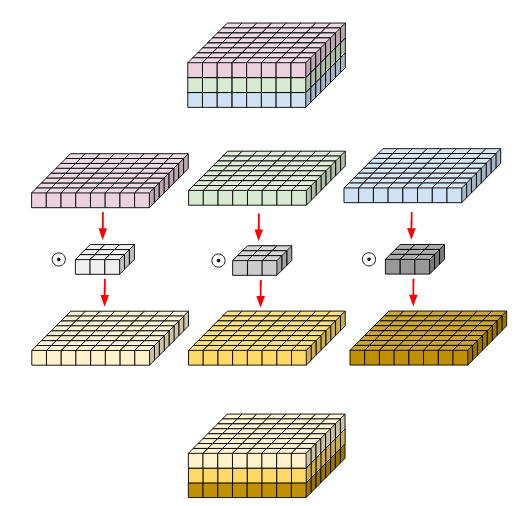
Depthwise convolution
Filter and input is broken channel-wise and convolved separately. After that, they are stacked together. Example
Number of operations are reduced here:
LAYER = Number of Kernel x Kernel Shape x Output Shape(without channel)
Pointwise convolution
1x1 Filter is applied on each pixel of input with same channel. Example
Number of operations are reduced here:
LAYER = Number of Kernel x Kernel Shape(1x1) x Output Shape(without channel)
